You are currently viewing the James Walker Australia & New Zealand website. Click here to view the Global website.


You are currently viewing the James Walker Australia & New Zealand website. Click here to view the Global website.

Thanks to their outstanding performance across a multitude of applications PFAS have become an integral element of modern life, from non‑stick cookware to electric vehicle batteries. As a result, the potential broad spectrum regulation of PFAS poses a major disruptive threat to global industry.
With common uses ranging from non‑stick cookware to electric vehicle batteries, the potential broad-spectrum regulation of PFAS poses a major disruptive threat to global industry.
Whilst a decision on the proposed regulation, and the likely timeline for implementation, are still being considered by the European Chemicals Agency (ECHA), James Walker has been proactively looking at, and qualifying, alternative materials and working with its suppliers to ensure sealing materials are available that will offer the required levels of performance and be compliant with any proposed regulations.
Our focus has been to eliminate the existence of PFAS surfactants in the manufacturing process and ensure a secure, long-term supply chain for our customers that is well equipped to address any potential upcoming legislative changes. We believe we have now achieved this goal across more 100% of the James Walker mainstream fluorocarbon elastomer range.
The countdown to the changeover to the new PFAS surfactant-free variants of our fluoroelastomers is now underway. We are currently briefing customers about the changeover whilst final testing to industry standards such as Norsok, ISO and API standards is approaching completion. A comprehensive validation pack will be published for each material as soon as this work is finalised and in the meantime, stock of the new materials is available for customers wanting to carry out their own testing or looking to specify a PFAS surfactant-free material for new projects and applications.
Timeline for the launch of James Walker mainstream materials manufactured without PFAS surfactants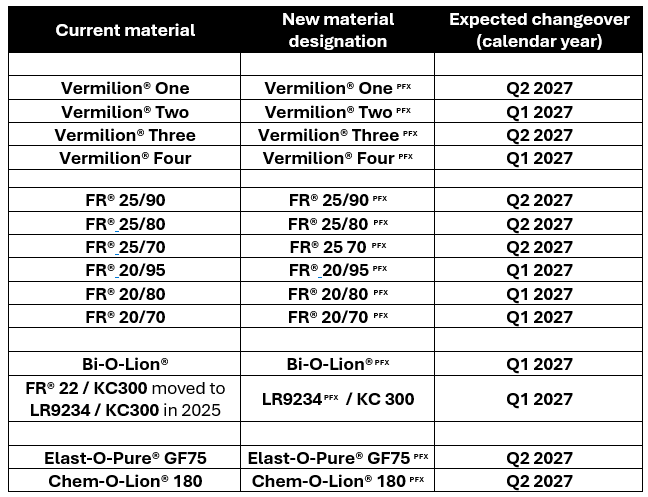
The information on this and other linked pages is designed to clarify the current situation and keep visitors informed of the latest developments in the regulation scenario. Should you have any specific questions, you can submit further enquiries to our PFAS Project Team by completing our online enquiry form.
Per- and polyfluoroalkyl substances (PFAS) are a large, complex group of manufactured chemicals that are used as ingredients in various everyday products from non-stick pans to fabric anti-stain and waterproofing treatments as well as sealing materials such as PTFE, plus FKM and FFKM elastomers.
The PFAS family comprises thousands of substances. At one extreme these include small molecule chemicals which are proven to cause harm to life. At the other end of the scale are materials such as PTFE and FKM elastomers which are generally considered as substances of low concern for which no scientific evidence exists to show these materials cause harm.
James Walker has been undertaking a programme to find new polymer materials that do not require the use of PFAS surfactants as processing aids – our aim being to have a replacement material for each of our current FKM materials.
We currently believe we now have suitable replacements identified for 100% of our mainstream fluoroelastomer materials and have published a timetable on the website. Final testing and validation is underway with sample product available for customers wishing to carry out their own testing.
Much of the media focus that has been published under the name of PFAS does not differentiate between the thousands of substances in the per- and polyfluoralkyl substances family.
The size and shape of a chemical at a molecular scale significantly impacts its properties. Small chemicals are mobile and more reactive than large polymers. They diffuse and permeate quickly between other chemicals and surfaces. The risk profile of a large chemical that cannot permeate and which is sluggish is totally different to one that can freely pass into human tissue and which is reactive and mobile.
A fully fluorinated material is water insoluble. Large fully fluorinated polymers, like PTFE, are solids with no affinity for water. By comparison PFAS surfactants are small molecule chemicals that are readily soluble in water. Water solubility can allow a chemical to enter the body through food and drink.
PFAS Surfactants, such as PFOA, PFOS and Gen-X, that have been identified as having high health risks are all small, water soluble, and surface active. On the other hand, the vast majority of PFAS materials used by the sealing industry are large polymers which are inert and water insoluble.
Although harmless in their natural state, the chemistry of PFAS polymers means they are incredibly stable and do not degrade under normal usage conditions. This is one of the reasons they are so popular for use in critical sealing applications and why they are known as 'forever chemicals'. The fact that these materials therefore accumulate in the environment is seen as building a potential future environmental disaster unless they are disposed of in a suitably safe manner.
The regulation of PFAS materials across Europe is a 'proposal' at this stage based on chemical structures rather than on hazard properties or risks based on PFAS prevalence, usage, and health effects. All PFAS, including polymers, fall under the scope of the proposed regulation, however, the current recommendation allows for extended use of PFAS materials where they are shown to be critical for socio-economic reasons and where no available alterative exists. The sealing industry believes that critical PFAS sealing materials should be granted an extension of use for this reason.
James Walker is actively working with the European Sealing Association to request such an exemption or extension of use for PFAS polymers in sealing applications. Regulation in Europe will take time to consider and come into force. The earliest possible enforcement in the EU will be from 2026 and if granted, extensions for use for socio-economic reasons could run up until 2039.
Some James Walker sealing materials are manufactured using PFAS base polymers. In some instances the whole product may be manufactured from PFAS polymer; O-rings manufactured in fluoro or perfluoroelastomer for example, or gaskets cut from PTFE sheet materials.
In other instances it may be less obvious - a compression packing that utilises a PTFE lubrication package or the sealing element in a semi-metallic gasket for example.
The proposed regulations however see no difference and any product containing any PFAS at all will potentially be subjected to the same restrictions - only a derogation based on the usage and application of a PFAS product will permit a product’s continued use after the enforcement date.
The lists below show key James Walker products that will be potentially affected by the proposed legislation. In some cases PFAS materials have been specified for applications where alternatives may exist. The European Sealing Association recently commissioned Ricardo PLC to assess impact of the proposed regulation to the sealing industry. Ricardo found that industry manufacturers believe that only 20% of product has the potential to be substituted in application with a non-PFAS alternative.
One potential possibility for the continued use of PFAS polymers is to manufacture these materials without using PFAS surfactants as a processing aid. The resulting material could have performance differences over existing counterparts, and James Walker is currently working with its polymer suppliers to formulate and test options.
James Walker products containing PFAS base polymers include;